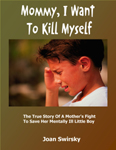
Excerpt from Book:
It is said that at one
profound moment, we all face our own mortality and look death in the eye.
But the death that Charlotte “Charley” Bednarsh saw one frigid January night
was not her own. The terrified, anguished look that met her gaze was in the
eyes of her ten-year-old son.
As he stood on the
slate-shingled roof of their cozy Colonial home, teetering precariously on
its edge and threatening to jump, her heart stopped.
“How did this happen?” she
agonized. “Why does my beautiful, sandy-haired son want so desperately to
die?” She wondered what kind of merciless demons had invaded his
still-developing mind, seized the health from his tender psyche, and taken
control of him so completely that reason – and love – were no longer enough.
She had no answers.
On that bone-chilling evening,
the doors shut tight against January’s icy air, her sons – Jonathan, twelve,
and Jeremy, ten – were quietly watching TV in their flannel pajamas. Nothing
seemed remarkably out of kilter when, all at once, Jeremy bolted upstairs.
Charley paid scant attention, so accustomed was she to his limited attention
span and his constant search for new and absorbing activities.
But suddenly, what had seemed
to be a tranquil evening was pierced by a bloodcurdling shriek.
“Mommy, Mommy, Mommy, help me,
help me!”
Jeremy’s outbursts were
familiar to Charley. Even before he could speak, he would hurl himself
against the bars of his crib or hit his head repeatedly on the floor. As he
got older, he screamed out in frustration or anger with increasing and
alarming frequency, flailing his arms at some imaginary target, destroying
his toys and the household furniture or dissolving into uncontrollable
tears.
As Charley raced up the
stairs, she expected to find her young son trapped once again in some
disconcerting situation – a toy that wouldn’t work, a drawer that wouldn’t
open – and she knew that he might be curled up in the fetal position, which
he often adopted when he felt stymied by even ordinary situations.
Flying through his bedroom
door, she felt a biting gust of wind that whipped across her face and coiled
insidiously into every cell of her body as she realized, with stunned
horror, that Jeremy was on the roof. Framed by the baseball-motif curtains
wafting eerily in the frigid breeze was the opened window, a sight she would
never forget.
Except for one sympathetic
neighbor who had, on numerous occasions before this terrifying evening,
called her at work to say that Jeremy had eluded the watchful eyes of his
babysitter and climbed out onto the roof, Charley’s problems had all been
“behind closed doors.” She had become all too familiar with the meaning of
that insinuating expression and its allusion to the deep, dark secrets of
people who barricade themselves against the grimmer aspects of their lives
and against the harsh glare of public scrutiny.
“Mommy, mommy, mommy, I’m
going to kill myself! I want to kill myself!” Jeremy yowled plaintively into
the night air.
I just finished reading "Mommy, I Want To
Kill Myself" and it was so riveting that I sat there with my heart pounding
in my chest. The mother in this story deserves a Congressional medal, as
does the older brother of Jeremy, because he could have used any number of
excuses, like neglect, jealousy, etc., for becoming dysfunctional himself,
which he didn’t.. But it was Jeremy, who suffered so deeply with bipolar
disorder, who is truly an example of God's hand in placing angels at
strategic places and times. Jeremy was meant to survive, and he helped
himself! A lesser soul would have perished, even with guardian angels all
around him. Unfortunately, much more needs to be done about mental illness,
but if one child can be saved, as Jeremy was, the struggle is worth it.
Ercille Christmas, author of “Thoughts of A
Proud American” (www.authorhouse.com)
*****
I thought I was going
to look through Joan Swirsky's book for a few minutes, but a few minutes
became two hours. I couldn’t put it down. It reads like a suspense
novel, full of the tragedy – and also triumph – that one only finds in
real life, a story told with compelling drama and heart-wrenching
imagery that proves the old adage that life is not for sissies. An
amazing story!
Lyle Rossiter, M.D.,
psychiatrist and author of
The Liberal Mind: The Psychological Causes of Political
Madness (Free
World Books, 2006)
*****
As parents, we feel
guilty for any unhappiness in our children’s lives. But Joan Swirsky’s
book should make every parent, pediatrician, and psychiatrist take a
second look at young children whose behavior is deviant from an early
age and rethink their preconceived notions. No doctor wants to medicate
a child, but as “Mommy” points out, in some cases it can be both
appropriate and life changing.
Eric Gould, M.D., New
York pediatrician and specialist in pediatric developmental issues
*****
Joan Swirsky’s book is
a riveting account of how one mother helped her young son, who was
eventually diagnosed with bipolar disorder, find healing and peace
despite the antagonism of many “helping professionals” who were better
at blaming the mother than helping the child. A must read for parents
and concerned professionals alike.
George Lynn, author of
“Survival Strategies for Parenting Children with Bipolar Disorder"
*****
Mommy, I Want to Kill
Myself is a
poignant account of a mother's journey into her young son's suicidal
mind. It examines the guilt, aching sorrow, and desperation faced by a
loving mother turned advocate. It is a beautifully told story that,
unfortunately, I, and many other moms, know only too well from the
inside out.
Judith S. Lederman,
author of “The Ups & Downs of Raising a Bipolar Child: A Survival Guide
for Parents”
*****
Among the most
devastated people in my practice are parents whose children are not just
unhappy, but deeply disturbed. Joan Swirsky’s can’t-put-down book has
illuminated the plight of children with mental illness, which – in too
many cases – has more to do with aberrant genes than bad parenting. This
book is an invaluable resource for all parents who battle “the system”
every day to save their children’s lives.
Judith Ehrenfeld,
Ph.D., R.N., C.S.